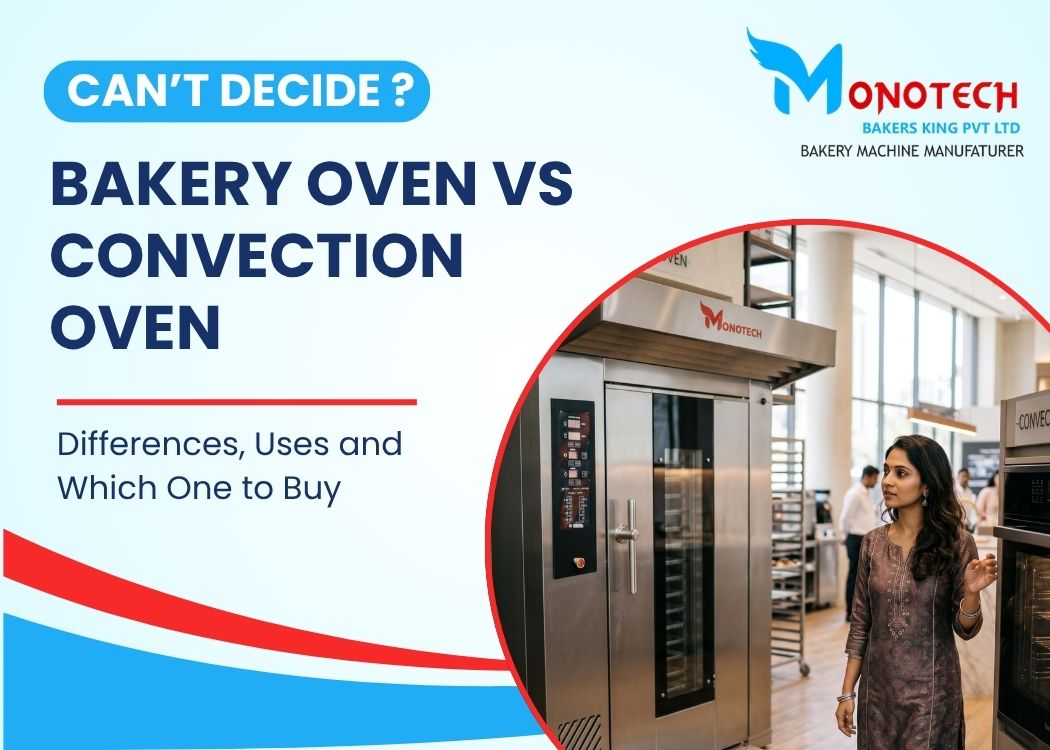
Bakery Oven vs Convection Oven: Differences, Uses and Which One to Buy
Bakery Oven vs Convection Oven: Which One Should a Bakery Buy?
Choosing the right oven is one of the most important decisions when setting up or expanding a bakery business. The quality of baking, production capacity, consistency of products and overall workflow depend significantly on the type of oven used. Among the commonly considered options, bakery ovens and convection ovens are popular choices for commercial baking applications.
However, many bakery owners have questions about the difference between a bakery oven and a convection oven. Are they the same? Which one is suitable for cookies, cakes, bread and other bakery products? Is a commercial convection oven sufficient for large-scale production, or should a bakery invest in specialised industrial bakery equipment?
Understanding how these ovens work, their applications and their differences can help you select the right equipment according to your production requirements.
What Is a Bakery Oven?
A bakery oven is a baking appliance specifically designed for preparing bakery products such as bread, cookies, cakes, biscuits, pastries and other baked foods. Commercial bakery ovens are available in different configurations to support the baking requirements of small bakeries, commercial production units and industrial food manufacturers.
Depending on the design, a bakery oven may use different heating arrangements and baking methods. Some ovens are designed for baking products in trays, while others support larger production operations through multiple racks or specialised baking systems.
Commercial bakery ovens are selected according to product type, tray dimensions, batch size, temperature requirements and expected production volume.
Common Types of Bakery Ovens
- Deck Oven: Commonly used for baking bread, pizza and other products that require controlled heat from the baking deck.
- Convection Oven: Uses circulating hot air to distribute heat throughout the baking chamber.
- Rotary Rack Oven: Uses rotating racks to support batch baking and consistent heat exposure across trays.
- Rack Oven: Designed to accommodate multiple trays for commercial bakery production.
- Tunnel Oven: Used in continuous industrial baking operations where products move through a heated baking chamber.
What Is a Convection Oven?
A convection oven is an oven that uses a fan to circulate heated air inside the baking chamber. This movement of hot air helps distribute heat around the products and can support more uniform baking across different tray positions.
Convection ovens are commonly used in bakeries, restaurants, hotels, cafes and commercial kitchens. They are suitable for preparing cookies, cakes, pastries, muffins and several other baked products, depending on the oven specifications.
How Does a Convection Oven Work?
A convection oven uses heating elements to generate heat and a fan to circulate the hot air inside the chamber. This circulation helps reduce temperature variations within the baking space and improves heat distribution around the products.
The baking result depends on factors such as temperature settings, airflow, product thickness, tray arrangement, baking time and the characteristics of the recipe.
Bakery Oven vs Convection Oven: Key Differences
The main difference is that a bakery oven is a broad category of equipment designed for baking, whereas a convection oven is a specific type of oven that uses forced hot-air circulation.
| Comparison | Bakery Oven | Convection Oven |
|---|---|---|
| Meaning | General category of ovens designed for bakery applications. | A specific oven type that circulates hot air using a fan. |
| Heating Method | Depends on the oven design and technology. | Uses heated air circulated by a fan. |
| Applications | Bread, cookies, cakes, biscuits, pastries and other baked products. | Cookies, cakes, pastries, muffins and other suitable products. |
| Production Capacity | Varies from small batch equipment to large industrial systems. | Varies according to chamber size and model. |
| Equipment Options | Deck ovens, rack ovens, rotary rack ovens and tunnel ovens. | Different chamber sizes and commercial configurations. |
| Best Selection Criteria | Product type, production volume and baking process. | Airflow, chamber capacity, temperature control and product requirements. |
Which Oven Is Better for Different Bakery Products?
Not every bakery product requires the same baking conditions. The right oven depends on the product recipe, texture, moisture level, baking temperature and production method.
1. Cookies and Biscuits
Cookie and biscuit production requires consistent baking conditions to achieve the desired colour, texture and product quality. Convection ovens can be suitable for smaller and medium-sized batches, while rotary rack ovens and tunnel ovens may be considered for larger production requirements.
For commercial cookie manufacturers, oven selection should also consider tray capacity, baking time, temperature consistency and compatibility with the cookie production process.
2. Cakes and Muffins
Cakes and muffins require controlled baking conditions to achieve the desired internal texture and structure. Convection ovens are commonly used for these applications, but the correct temperature and airflow settings are important to prevent uneven baking.
3. Bread and Buns
Bread and bun production requires suitable heat distribution and baking conditions to develop the expected crust, colour and internal texture. Deck ovens and rack ovens are commonly considered for commercial bread production, depending on the product and production capacity.
4. Pastries and Other Bakery Products
Pastries and speciality bakery products may require specific temperature and airflow conditions. The selection of an oven should be based on the recipe, product characteristics and the consistency required across batches.
Advantages of Using a Commercial Bakery Oven
Investing in a suitable commercial bakery oven can help businesses manage their baking operations more effectively. Important advantages include:
- Production Flexibility: Different oven configurations are available for different bakery products.
- Batch Processing: Commercial ovens can accommodate multiple trays or racks depending on their design.
- Temperature Control: Suitable temperature settings help maintain the required baking conditions.
- Business Scalability: Different oven capacities allow bakeries to select equipment according to their production requirements.
- Product Consistency: Properly selected and operated ovens help maintain consistent baking results.
Advantages of Using a Commercial Convection Oven
A commercial convection oven offers several benefits for bakeries and food businesses that require controlled hot-air circulation.
- Hot-Air Circulation: The fan helps distribute heated air throughout the baking chamber.
- Multiple Tray Baking: Suitable models can accommodate several trays simultaneously.
- Versatile Applications: Can be used for different bakery products depending on the oven specifications.
- Temperature Management: Adjustable temperature settings help operators manage different baking requirements.
- Commercial Kitchen Use: Suitable models can support bakery, restaurant, cafe and hotel operations.
What Factors Should You Consider Before Buying a Bakery Oven?
Before purchasing a bakery oven for commercial use, it is important to evaluate your current production requirements and future business plans.
1. Type of Bakery Products
Identify whether your business primarily produces cookies, cakes, bread, biscuits, pastries or multiple products. Different products may require different baking methods and oven configurations.
2. Production Capacity
Calculate the number of trays or batches you need to bake during your working hours. Choose an oven with suitable capacity to support your expected production quantity.
3. Temperature Control
Check the available temperature range, temperature adjustment system and heat distribution characteristics. Consistent operating conditions are important for maintaining product quality.
4. Energy Consumption
Evaluate the oven's power or fuel requirements, insulation, operating hours and overall energy consumption. These factors contribute to the ongoing cost of bakery operations.
5. Space and Installation Requirements
Consider the available floor space, tray handling arrangements, ventilation, electrical connections and installation requirements before finalising your purchase.
6. Maintenance and Technical Support
Understand the cleaning procedures, maintenance requirements, spare parts availability and technical support offered by the manufacturer.
Bakery Oven Price: What Determines the Cost?
The bakery oven price varies according to the oven type, capacity, heating system, construction, features and manufacturing specifications. A small commercial convection oven and a large industrial rotary rack oven have very different configurations and cost structures.
Some of the main factors that influence oven pricing include:
- Oven type and design.
- Number of trays or rack capacity.
- Electric, gas or other heating arrangements.
- Temperature control and operating features.
- Insulation and construction materials.
- Automation and additional configurations.
- Installation and service requirements.
For an accurate quotation, share your product details, required production capacity, preferred oven type and available installation space with the equipment manufacturer.
Common Mistakes to Avoid When Buying a Commercial Bakery Oven
- Choosing an oven based only on its purchase price.
- Ignoring the actual production capacity required.
- Not checking whether the oven is suitable for the intended products.
- Overlooking energy consumption and operating expenses.
- Ignoring installation, cleaning and maintenance requirements.
- Not checking technical support and spare parts availability.
- Purchasing equipment without understanding its operating specifications.
Frequently Asked Questions
Choose Bakery Machinery According to Your Production Needs
Both bakery ovens and convection ovens have important roles in commercial baking. The right choice depends on what you manufacture, how much you produce and the baking conditions required for your products.
Before investing in an oven, compare its specifications, capacity, operating requirements and suitability for your production process. Selecting the right equipment can help create a more organised and efficient bakery operation.
Monotech Baker's King Pvt. Ltd. provides bakery machinery for commercial bakery and food production applications, including cookie drop machines, wire-cut cookie machines, planetary mixers, cake depositors, spiral mixers, bread slicers and cream-filling machines.
Explore the available bakery machinery and discuss your production requirements with the Monotech team.
Enquire Now